Interference after AIS installation: preparing an EMC assessment
RS and RKO rules: practical application
The VHF radio worked reliably before the refit. After an AIS unit, display or new converter was added, noise appeared on reception. The timing helps define the problem but does not identify the faulty unit. A useful service enquiry needs a reproducible account: which equipment is operating, the mode in which the interference occurs, and what changes during authorized switching.
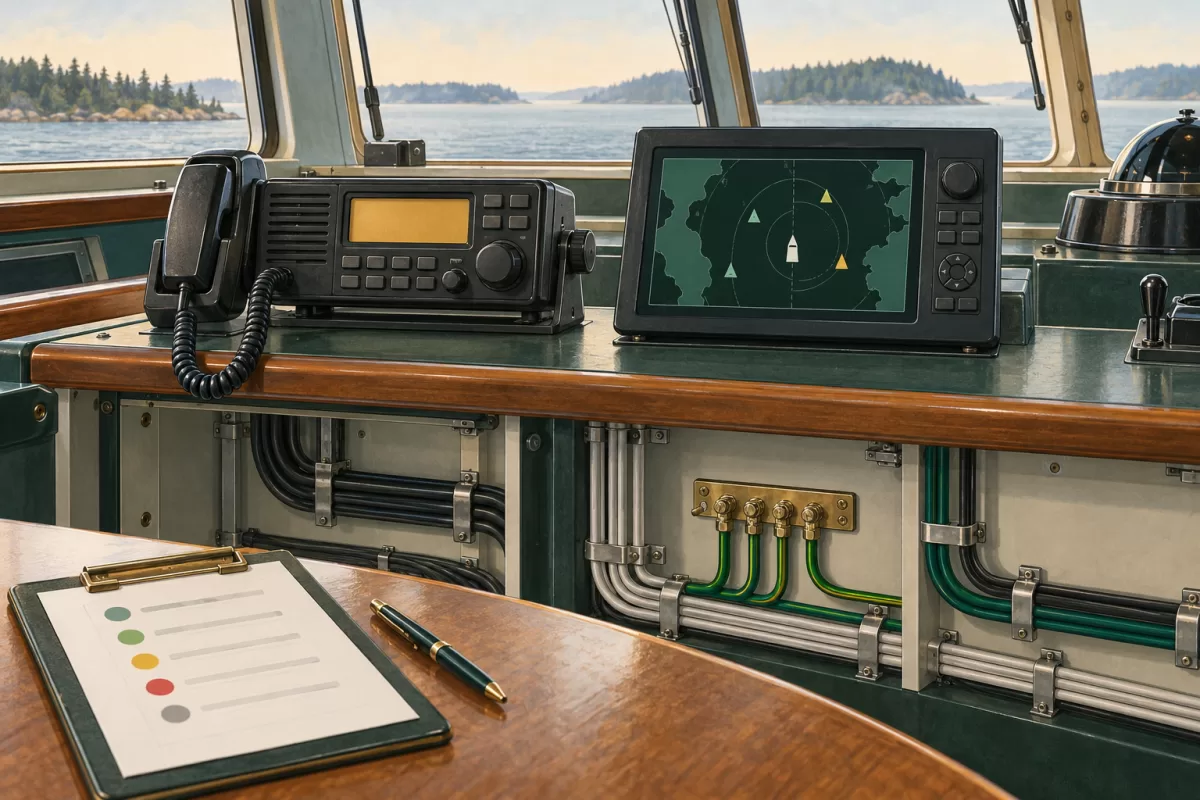
The requirement concerns the complete equipment combination
Paragraph 6.2.1 of Part VII, “Radio Communications Equipment”, of the RKO PKPS requires reasonable and practicable measures to ensure electromagnetic compatibility between newly installed equipment and existing radio and navigation equipment. It addresses interference in both directions: radio installations must not cause harmful interference to other shipboard systems, and other systems must not interfere with radio installations. It also specifies compliance with manufacturers’ instructions on EMC, shielding and earthing.
Testing only the new display away from the vessel is therefore insufficient to assess the whole installation. The opposite inference is also invalid: interference appearing after installation does not prove that the selected model is always incompatible with that radio. Examine the actual equipment, power supplies, antenna systems, connections and cable routing.
The new Part VII has been effective since 3 April 2026. Establish applicability to the particular vessel under paragraph 1.1.2, its current documents and the relevant requirements. This guide explains practical preparation for an assessment under 6.2.1; it does not prescribe a universal earthing arrangement.
Record the observations first
Record the affected receiver and channel or operating mode, how the interference presents, when it was noticed, and the preceding work. Compare operating modes of the new equipment without arbitrarily interrupting a required watch. Any switching on a vessel in service must be agreed with those responsible for its operation and performed under permissible conditions.
Distinguish continuous noise, short pulses, reduced sensitivity and equipment restarting. Restarting may indicate a power-supply issue; it must not automatically be classified as radio-frequency interference. “The screen goes blank during transmission” and “the receiver produces crackling when the backlight is on” require different supporting information.
| What to record | Why it is needed |
|---|---|
| Exact equipment configuration before and after the work | Distinguish newly added components from retained equipment |
| Operating mode in which the effect occurs | Enable the specialist to reproduce the observation |
| Type of change observed on each device | Distinguish reception interference, data loss and power-supply faults |
| Actual cable routes and terminations | Compare the installation against the manufacturers’ manuals |
This is a working record for a service enquiry, not a list of measurements mandatory for every vessel.
The radio and AIS unit are separate parts of the installation
The River Marine Pro catalogue includes the NSR NVR-3000 VHF GMDSS radio and NSR NSI-1000 Class A AIS transponder. To discuss their installation, specify the complete arrangement: their antennas, actual feeder cables, data cables, power supplies, shielding and locations. Using the same brand does not replace assessment of the actual configuration.
A general photograph is not a sufficient basis for recommending shared antenna systems, a splitter or an arbitrary adapter. Such arrangements are permissible only where supported by the applicable documentation and design. If existing cables are retained, include them explicitly in the solution description: the new equipment connects to the actual system, not an idealized diagram.
When preparing an NSI-1000 order, identify nearby existing equipment and the part of the installation being changed. Accessories and work can then be agreed as parts of one installation. The price of an individual device does not automatically include cable rerouting, measurements or correction of earlier findings.
A correction needs a result that can be checked
The specialist compares the actual installation with the manuals and determines the measurements and corrective work required. After the work, return to the original observation: has the effect disappeared in the same authorized operating mode, and does the affected equipment still operate normally? Record any changes to connections, cable routes or equipment configuration in the installation documentation.
Do not begin with blanket advice to “fit ferrites everywhere” or compromise protective earthing to reduce noise. Such measures may mask the symptom, create another problem and fail to demonstrate compliance with 6.2.1. The objective is a result addressing the actual cause, not a count of accessories added.
Information to send with the enquiry
State the vessel, equipment models, recent work and a short table of observations. Attach available diagrams and photographs of connections without opening equipment carrying dangerous voltages. When selecting a new NSR NSI-1000 list the radio and navigation equipment to be retained. For an existing installation, define the task as diagnosis of a specific effect, with agreed conditions for checking the result after correction.
Sources and scope of this guide
Sources: Official Part VII of the RKO PKPS, Order No. 29-p, paragraphs 1.1.2 and 6.2.1; Amendments No. 70-p. The observation record and approach to defining the task are editorial explanations. They do not replace installation manuals, the design or a professional assessment of the particular vessel.