DSC alarms: the call must be noticeable throughout the bridge
RS and RKO rules: practical application
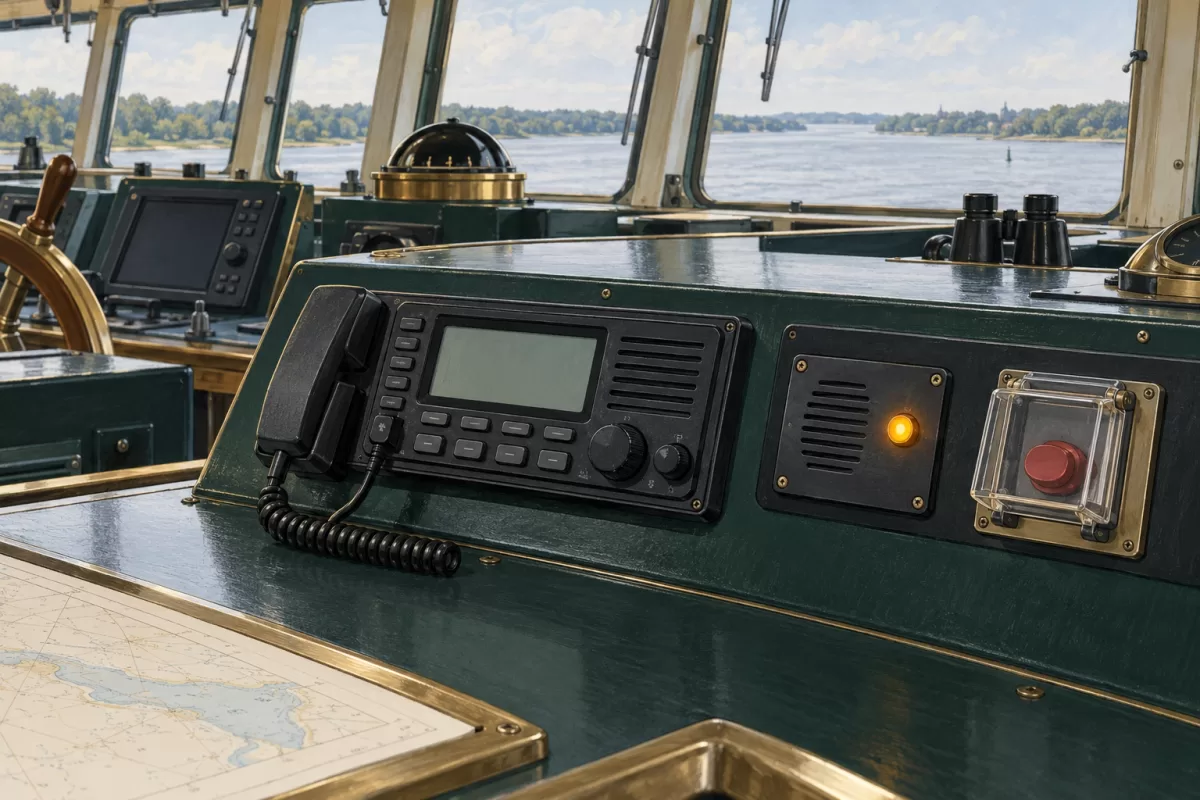
The DSC receiver received a message, but the watchkeeper could hear the alert only when standing beside the radio. A working display alone does not establish that the alarm arrangement is suitable for bridge operations. When modifying a console, adding a control unit or relocating a loudspeaker, separately assess audibility, visibility and acknowledgement.
What the RKO rules expressly require
Paragraph 4.2.7 of Part VII of the RKO PKPS requires audible and visual alarms for the received alerts specified there. These alarms must not be capable of being disabled, must have manual acknowledgement, and must be testable. The requirements for non-disablement and acknowledgement concern different functions: acknowledging a received signal does not authorize permanent suppression of future alerts.
Paragraph 4.2.8 requires the VHF DSC watch receiver on channel 70, the MF DSC watch receiver on 2187.5 kHz, and the scanning HF DSC watch receiver to be positioned so that the corresponding alarm is clearly audible and visible throughout the navigating bridge. Paragraph 4.2.9 also requires DSC warning messages to be readable on the bridge. Where a printer or display is shared, messages received simultaneously must be queued for subsequent output.
This guide addresses Part VII, “Radio Communications Equipment”, effective from 3 April 2026, with subsequent amendments. For a vessel in service, establish applicability under paragraph 1.1.2 and the vessel’s documentation. These requirements cannot be replaced by a general claim that “the radio supports DSC”.
Describe the acceptance scenario first
Identify where watchkeepers normally work: at the steering position, radio console, navigation station or another part of the bridge. Mark partitions, opening doors and equipment that obstructs the indicator. This information supports an assessment of the whole bridge; it is not a basis for inventing permissible sound levels or distances.
Use the installed equipment’s documentation to establish the test mode and expected indications. The result should answer three separate questions: is the alert visible, is it audible, and can the message itself be received and read? Agree the acceptance scenario before installation is signed off, so that a missing indicator or display location can be addressed before handing over the console.
An additional handset does not meet all three needs
The catalogue includes the NSR NVR-3000 VHF GMDSS radio. If it is being considered for a radio station, agree the main unit, accessories and required operating positions separately. An additional handset does not by itself establish that every DSC alarm, indication and function is reproduced at the remote position.
For an installed radio, establish the exact version and actual arrangement: which receiver maintains the watch, where the audible alarm sounds, where the visual alarm appears, which control acknowledges it, and where messages are read. Confirm the functions of each accessory against its manual and the proposed package. Do not assign display functions to an external loudspeaker or treat every remote handset as an independent watch receiver.
Check the alarms without transmitting a false distress alert
The rules require the audible and visual alarms to be testable. Use the manufacturer’s specified mode and an agreed procedure. Pressing the protected DISTRESS button to demonstrate operation is not a normal method of alarm acceptance testing.
If testing with external equipment or message exchange is specified, follow the established procedure with the responsible specialist. This article does not provide a distress-transmission sequence or replace instructions for cancelling a false alert. Those instructions, together with the DSC instructions, are among the documents to be available on the bridge under paragraph 4.2.12.
| Observation during testing | What to establish about the installed arrangement |
|---|---|
| The audible alarm can be heard only beside the equipment | Actual alarm outputs and audibility elsewhere on the bridge |
| A new screen obstructs the indicator | Signal visibility from operating positions and equipment placement |
| The message cannot be found after acknowledgement | Reading and storage procedure, the display used and its manual |
| The second position supports voice communication but does not show the alert | Confirmed remote-kit functions and the required outcome |
This table sets out acceptance questions. It does not introduce an additional regulatory requirement or authorize disabling a required watch.
Information needed to agree the equipment package
Attach a bridge plan showing the operating positions, the existing radio designation and the functions required. For a new NSR NVR-3000 define voice communication, alarm reception and DSC message reading separately. The quotation can then describe a configuration that can be checked, and the completed work can deliver what the watchkeeper needs to see and hear.
Sources and scope of this guide
Official Part VII of the RKO PKPS, Order No. 29-p: paragraphs 1.1.2, 4.2.7–4.2.9 and 4.2.12; Amendments No. 70-p. The approach to agreeing operating positions and the observation table are editorial recommendations. Establish the parameters and modes of the particular version from its documentation.